

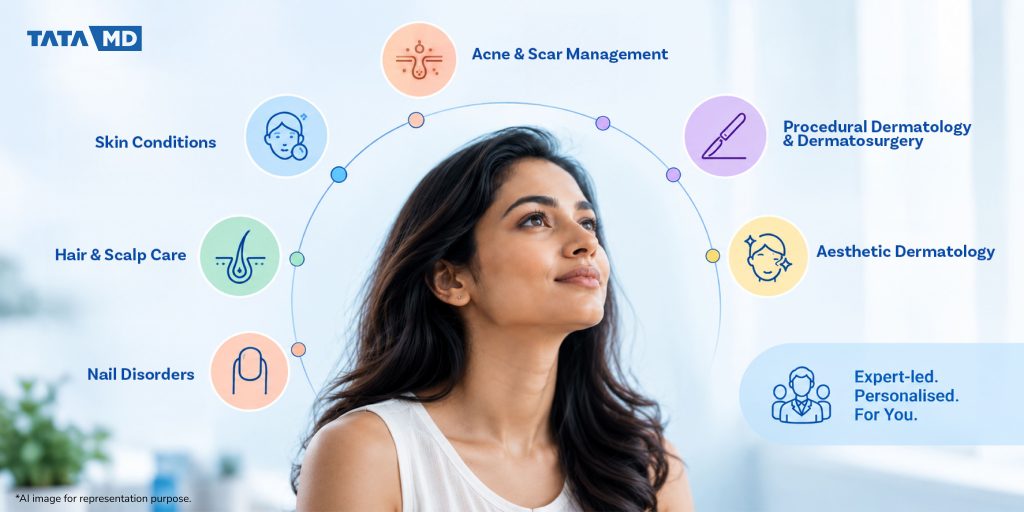
Dermatology is often perceived as a specialty dealing mainly with creams, rashes and acne. In reality, it encompasses much more from medical treatment of skin, hair and nail disorders to dermatosurgery, scar management and aesthetic procedures.
In everyday practice, I see patients who have often tried several treatments before coming for a consultation. Someone with acne has changed products repeatedly, a patient with hair loss has started multiple supplements, or a recurrent rash has been treated with different creams without a definite diagnosis.
The common thread is simple: a visible skin or hair problem does not always tell us what is happening underneath.
A rash may be fungal, eczematous, allergic or inflammatory. Hair loss may represent temporary shedding, pattern hair loss or more than one process occurring together. Pigmentation may follow inflammation, be related to melasma or have another underlying cause.
For me, good dermatology begins with getting that distinction right.
Our skin is constantly interacting with the environment. In India, ultraviolet exposure, heat, humidity, pollution and lifestyle can all influence skin health. In Bengaluru, patients commonly present with concerns such as acne, dandruff, pigmentation, fungal infections, eczema and hair loss.
But environmental exposure is only one part of the story.
Genetics, hormones, nutrition, medications, occupation, stress, skin-care practices and underlying medical conditions may all contribute to a dermatological problem. That is why two people with what appears to be the same complaint may require completely different approaches.
A recent multicentre study involving 6,169 patients across four regions of India reported fungal infections in 26.1% of cases and also found acne, psoriasis, eczema, melasma and alopecia among commonly encountered conditions.
The broader message is more relevant than any individual number: dermatology covers a remarkably wide range of conditions, and accurate diagnosis remains the starting point for treatment.
Acne is one of the most familiar dermatological conditions, but it is also one of the conditions most commonly self-treated.
For some people, acne is occasional and settles with simple measures. For others, it is persistent, painful and associated with pigmentation or scarring. Adult acne may also have hormonal or other contributing factors that need to be considered.
I generally advise patients not to wait until significant scarring has developed before seeking treatment.
Treatment depends on the type and severity of acne, the tendency to scar, pigmentation, previous treatments and, where relevant, associated hormonal or metabolic factors. The objective is not simply to clear today’s lesions. It is to control the disease, reduce new breakouts and minimise the risk of permanent scarring.
And when acne has already left scars, treatment does not necessarily end with controlling the acne.
One of the more rewarding parts of dermatology is helping patients after the active disease has been brought under control.
Acne may have settled, but pigmentation or scars can remain. A skin condition may have resolved, but the patient may still be concerned about texture or visible marks.
This is where procedural dermatology can become relevant.
Depending on the diagnosis and the type of scar or pigmentation, options may include chemical peels, microneedling, platelet-based procedures and other evidence-based interventions. The choice of procedure should be based on the clinical problem rather than on a particular procedure being popular at a given time.
Different acne scars, for example, require different approaches. Rolling scars, boxcar scars and ice-pick scars do not behave in the same way, and simply performing the same procedure for every patient is unlikely to produce the best result.
The same principle applies to pigmentation: before treating pigmentation, it is important to understand what is causing it.
Hair loss is probably one of the areas in which patients receive the greatest amount of conflicting advice.
Biotin, vitamin D, protein supplements, oils and specialised shampoos are frequently recommended without first establishing the type of hair loss.
But the first question should be:
Hair shedding may follow fever or illness, significant stress, weight loss or nutritional deficiencies. There are also genetic forms of hair loss, scalp disorders, hormonal factors and other medical causes.
The pattern of hair loss is often as important as the amount of hair being shed. During consultation, we assess the scalp and hair, distribution and characteristics of the loss, relevant medical history and lifestyle factors. Trichoscopy can be useful in selected cases, while blood investigations are advised when the history and examination suggest they are warranted.
Not every patient with hair fall needs a long list of blood tests, and not every patient needs a supplement.
The treatment should follow the diagnosis.
Nails are often overlooked until the change becomes obvious.
Thickening, discoloration, brittleness, separation of the nail from its bed or changes in nail shape can have several causes. Fungal infection is one possibility, but it is not the only one.
Repeated trauma, inflammatory skin disorders and systemic or nutritional factors can also affect the nails.
Not every thick or discoloured nail is fungal. When the diagnosis is uncertain, appropriate clinical assessment and, where required, laboratory or microscopic confirmation can prevent months of inappropriate treatment.
When dermatology requires a procedure
There are also situations where medication alone is not enough.
A suspicious or persistent skin lesion may require a skin biopsy to establish the diagnosis. Warts, cysts, benign growths and other lesions may require procedures such as excision, cauterisation or intralesional treatment. Certain nail conditions and other localised problems may also require minor surgical intervention.
This is where dermatosurgery forms an important part of dermatology.
The procedure itself is only one component. Choosing the correct procedure, understanding the anatomy, controlling bleeding, minimising tissue damage and planning wound care and scar management are equally important.
A lesion should not simply be removed because it can be removed. The diagnosis and the reason for intervention should come first.
Dermatology also has an important aesthetic dimension.
Patients may seek treatment for concerns related to pigmentation, acne scars, skin texture, photoageing, fine lines, hair density or other changes in appearance. These concerns may not represent a disease in the conventional sense, but they can still have a meaningful effect on how a person feels about themselves.
Aesthetic dermatology should therefore not be viewed simply as a collection of cosmetic procedures.
The starting point should remain a proper assessment of the skin, the patient’s concern and what can realistically be achieved. Depending on the indication, treatment may involve topical or medical therapy, peels, platelet-based procedures, injectables or other dermatological procedures.
The aim should be improvement, not an unrealistic promise of perfection.
A dermatology consultation should involve more than identifying a condition and writing a prescription.
I like to understand what the patient has noticed, how long it has been present, what has already been tried and how the problem is affecting them. Examination then helps narrow the diagnosis and determine whether further assessment is required.
Depending on the problem, this may include dermoscopy, trichoscopy, targeted blood investigations, a biopsy or another procedure. Not every patient needs investigations, and not every patient needs a procedure.
Once the diagnosis is established, treatment should be discussed honestly — including how quickly improvement can be expected, what limitations exist, possible adverse effects and whether ongoing treatment or follow-up will be necessary.
This is particularly important in dermatology. Many conditions improve gradually, and some require sustained treatment rather than a quick fix.
At Tata MD, our approach is to look beyond the immediately visible symptom and understand the patient and the condition in context.
Medical dermatology, hair and scalp disorders, nail disease, dermato surgery and aesthetic dermatology are all part of the specialty. The appropriate combination depends entirely on the patient’s diagnosis and treatment goals.
For some patients, the answer may be a simple topical treatment. For another, it may require systemic medication and follow-up. Someone else may benefit from a procedure once the underlying condition is controlled. In selected cases, surgery or a combination of medical and procedural treatments may be appropriate.
The objective is not to prescribe more treatment or perform more procedures. It is to choose the right treatment, for the right patient, at the right stage.
If a skin, hair or nail concern is persistent, recurrent, changing or difficult to understand, getting a proper dermatological assessment is often the most useful place to begin.
Sources

Tata MD Healthcare Centre, 2nd Floor Prime Square, Sathya Sai layout, Whitefield, Bengaluru, Karnataka Pincode: 560066
View on Google Map
Monday to Saturday | 08:00 AM - 08:00 PM
Sunday | 10:00 AM - 02:00 PM