



Rheumatoid arthritis is more than joint pain. Early diagnosis can help protect mobility, reduce complications and improve long-term quality of life.
Joint pain is often ignored as a consequence of age, overuse or everyday fatigue. But persistent pain, swelling and morning stiffness, particularly when they affect several joints, can sometimes point to a chronic inflammatory condition such as rheumatoid arthritis (RA).
Rheumatoid arthritis is an autoimmune disease in which the immune system mistakenly attacks healthy tissues, especially the lining of the joints. Without appropriate treatment, persistent inflammation can progressively damage joints and surrounding tissues.
What makes rheumatoid arthritis particularly important to recognize is that its impact may extend beyond the joints.
Rheumatoid arthritis commonly causes pain, stiffness, tenderness, warmth and swelling in the joints, particularly the small joints of the hands, wrists and feet.
However, RA is a systemic inflammatory disease. According to the World Health Organization, it can also be associated with problems involving the heart, lungs and nervous system. It can affect mobility, the ability to perform everyday activities and, over time, a person’s independence and overall wellbeing.
The scale of the condition is significant.
Global estimates published in The Lancet Rheumatology suggest that around 17.6 million people worldwide were living with rheumatoid arthritis in 2020, with the number projected to increase substantially by 2050.
India is also experiencing a growing burden of rheumatoid arthritis. An analysis based on the Global Burden of Disease 2021 database estimated that approximately 2.77 million people in India were living with RA in 2021. Of these, around 2.06 million were women, highlighting the substantially higher disease burden among women.
When it comes to rheumatoid arthritis, time matters.
Inflammation may begin damaging the joints relatively early in the course of the disease. Delaying medical evaluation and relying only on temporary pain relief can allow the underlying inflammatory process to continue.
Early diagnosis gives doctors an opportunity to identify the condition, assess disease activity and initiate appropriate treatment before significant and potentially irreversible joint damage develops.
The World Health Organization notes that early diagnosis and management can reduce symptoms, slow disease progression and help prevent disability.
This is why recognising early symptoms and seeking medical evaluation should be an important part of rheumatoid arthritis care.
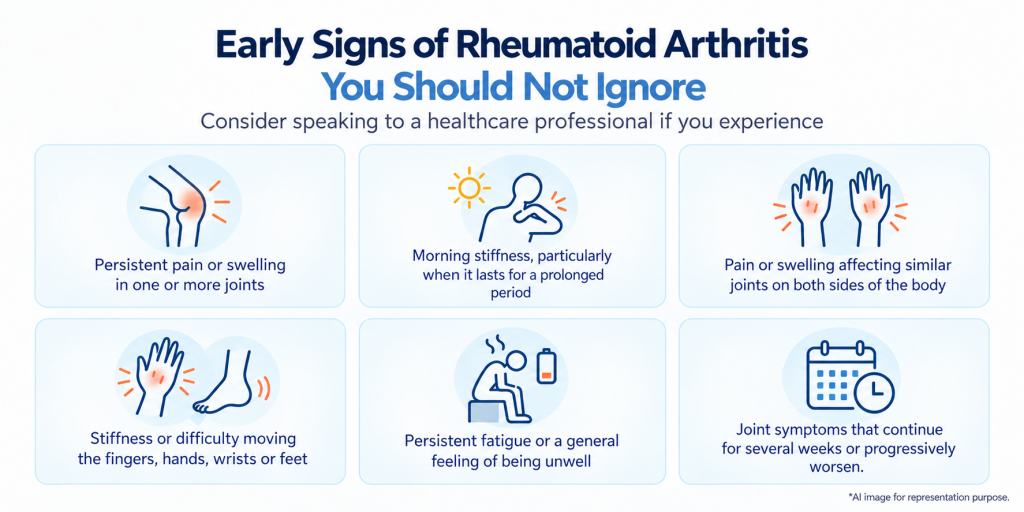
Consider speaking to a healthcare professional if you experience:
Rheumatoid arthritis frequently affects joints symmetrically for example, both hands or both feet and may make everyday activities such as writing, holding objects, walking or climbing stairs increasingly difficult.
There is no single test that confirms rheumatoid arthritis in every patient.
Diagnosis generally involves a combination of medical history, clinical examination, blood investigations and, where required, imaging.
Doctors may evaluate inflammatory markers and tests such as rheumatoid factor and anti-cyclic citrullinated peptide antibodies, along with the pattern, duration and severity of symptoms.
An accurate diagnosis also helps distinguish rheumatoid arthritis from other common causes of joint pain, including osteoarthritis.
Modern rheumatoid arthritis care focuses not only on relieving pain but also on controlling the underlying disease process.
Depending on the individual, treatment may include disease-modifying medicines, symptom management, exercise, physiotherapy, rehabilitation and lifestyle support.
Regular monitoring is equally important because rheumatoid arthritis is a long-term condition whose activity can change over time.
At Tata MD, we believe chronic conditions benefit from care that extends beyond an isolated consultation.
For people experiencing persistent joint symptoms or living with a chronic condition such as rheumatoid arthritis, a connected approach can support timely clinical evaluation, appropriate specialist referral, personalised care planning and continued monitoring.
Coordinated care can also help patients address other aspects of long-term health from mobility and nutrition to associated metabolic and cardiovascular risks based on individual clinical needs.
The goal is not simply to respond when symptoms worsen, but to support patients throughout their health journey.
Occasional aches and pains are common. Persistent inflammation, swelling and stiffness are different.
If joint symptoms are affecting everyday activities or continuing for several weeks, seeking medical advice early may help uncover the underlying cause and enable appropriate treatment sooner.
Rheumatoid arthritis may begin with joint pain, but its impact can extend much further. Early recognition, timely diagnosis and continued care can help protect mobility, independence and long-term quality of life.

Tata MD Healthcare Centre, 2nd Floor Prime Square, Sathya Sai layout, Whitefield, Bengaluru, Karnataka Pincode: 560066
View on Google Map
Monday to Saturday | 08:00 AM - 08:00 PM
Sunday | 10:00 AM - 02:00 PM