


Supplements have become part of daily life for millions of Indians: Vitamin D, B12, calcium, iron, omega-3, and multivitamins. In our own practice at Tata MD, we see the majority of urban patients already on at least one supplement, often self-prescribed from social media or a quick online search. The instinct is understandable, because deficiency in India is genuinely common. But the science of supplements is not “take more.” It is “take the right thing, at the right time, for the right reason.” Getting the timing or the combination wrong can quietly cancel the benefit or cause a new problem. Here is what the data shows, and what a wellness reel won’t tell you.
India carries a heavy micronutrient burden, which is why blanket supplementation feels justified. A national systematic review and meta-analysis estimated a pooled prevalence of roughly 54% for iron deficiency and 53% for vitamin B12 deficiency, with folic acid deficiency at 37%. For vitamin D, a nationwide Metropolis Healthcare analysis of over 22 lakh test results (2019–January 2025) found that 46.5% of individuals tested were vitamin D deficient, with a further 26% in the insufficient range and deficiency was highest in teenagers, at 66.9%. Vitamin B12 deficiency is especially relevant here because around 29% of the Indian population is vegetarian, and B12 comes almost entirely from animal foods.
The key point: deficiency is common at a population level but your individual status can only be known by testing, not assumed. This is exactly why the same supplement helps one person and is useless (or harmful) for another.
Even when a supplement is genuinely needed, how you take it decides whether it works.
1. Your diabetes tablet can quietly deplete your B12. Metformin is India’s most prescribed diabetes drug and impairs B12 absorption. Evidence suggests metformin impairs vitamin B12 status primarily in a dose- and duration-dependent manner, by disrupting how the B12 intrinsic factor complex is taken up in the ileum. The trap: the resulting nerve tingling is easily mistaken for diabetic neuropathy, so nobody checks B12. If you’re vegetarian and on long-term metformin, you carry two independent hits to the same vitamin.
2. Calcium and thyroid tablets must be kept hours apart. Taken together, calcium binds levothyroxine in the gut. The FDA drug label explicitly states that calcium supplements and antacids decrease levothyroxine absorption and must be separated by at least 4 hours, and calcium can reduce levothyroxine absorption by 20–25%. The same 4-hour rule applies to iron. Practical fix: thyroid tablet on an empty stomach in the morning, calcium with lunch or dinner.
3. How you take iron decides if it works at all. Iron from tablets and plants is poorly absorbed, and your kitchen swings it dramatically. Vitamin C enhances non-heme iron absorption by converting ferric iron to the more soluble ferrous form and by counteracting inhibitors including phytates, polyphenols in tea and coffee, and calcium. On the other side, coffee can cut iron absorption by 60–90%, and tea has a similar effect. So, an iron tablet chased with chai is money down the drain, but the same tablet with a glass of nimbu paani works far better.
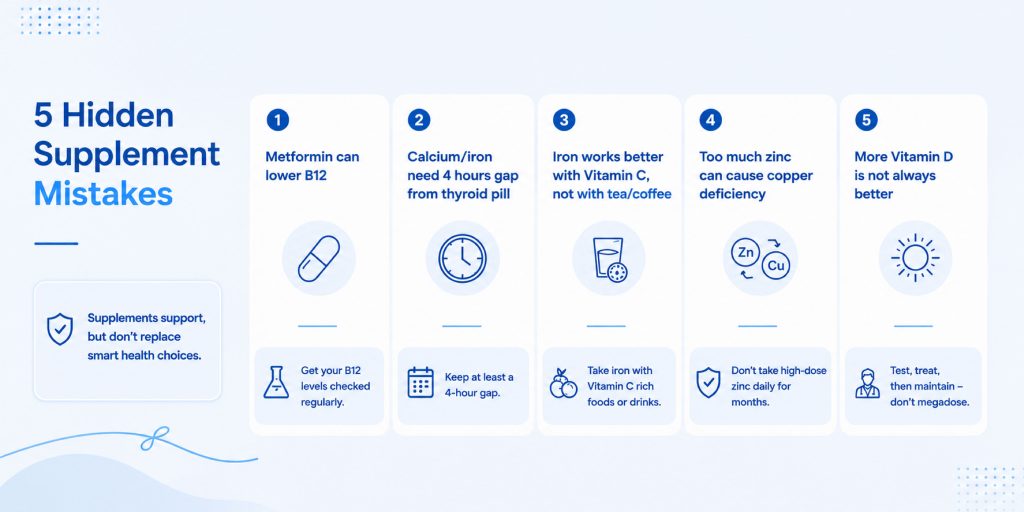
4. Daily “immunity” zinc, for months, can cause a copper deficiency. Zinc is safe short-term, but chronic excess competes with copper. The tolerable upper intake level for zinc is 40 mg/day for adults, and long-term intake above this level can result in copper deficiency, presenting as anemia, low white cell counts, and neurological symptoms that don’t always fully reverse. A cold lozenge for a week is fine; a high-dose zinc capsule every day for a year is not.
5. More vitamin D is not safer. Fat-soluble vitamins accumulate. The upper limit of safety for cholecalciferol is proposed to be 4000 IU/day. Correct a proven deficiency under guidance, then maintain; don’t megadose on a hunch bought online.
So, what should you do? Talk to your doctor with the right questions
None of these interactions is visible without the right test and the right question. That is the entire gap between guessing and evidence-based care, and it’s where Tata MD’s model of patient-centric consultation adds value. Before your next supplement or before continuing one you’ve taken for months, ask three things:
If you can’t answer all three, that’s a conversation with a qualified physician, not a purchase. Because true longevity isn’t built on the highest number of pills. It’s built on testing when needed, treating what’s real, and timing it right.

Tata MD Healthcare Centre, 2nd Floor Prime Square, Sathya Sai layout, Whitefield, Bengaluru, Karnataka Pincode: 560066
View on Google Map
Monday to Saturday | 08:00 AM - 08:00 PM
Sunday | 10:00 AM - 02:00 PM