


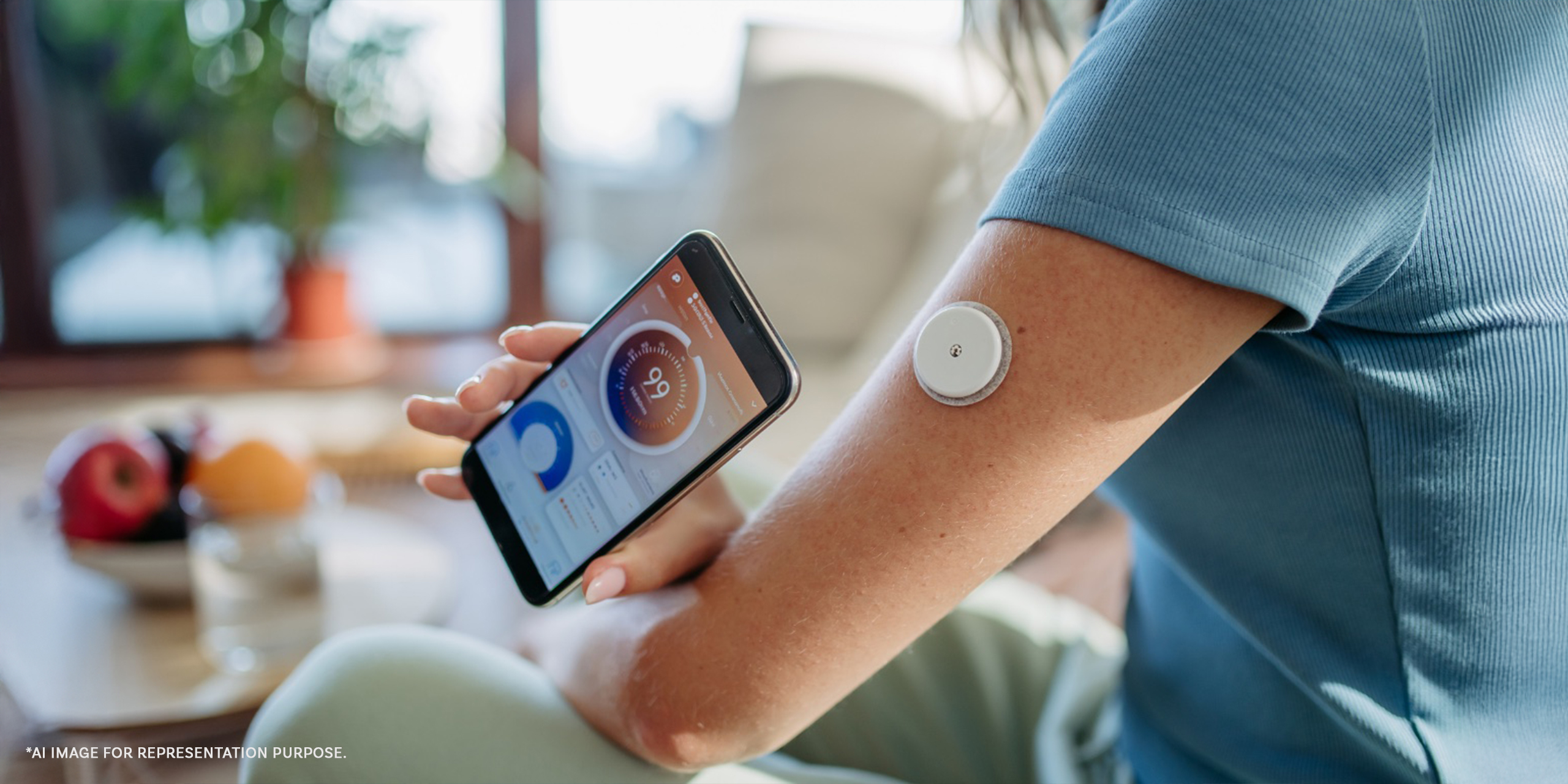
For a long time, Continuous Glucose Monitoring (CGM), a small wearable sensor that reads your sugar levels around the clock, was thought of as a tool only for diabetes. That picture is changing. The same technology can now reveal a great deal to people without diabetes who live with closely linked conditions such as thyroid disorders, PMOS, or high blood pressure.
Many of these conditions quietly shift how your body handles energy, often in ways a single blood test never catches. By following glucose day and night across food, movement, stress, and sleep, CGM helps you and your doctor see how your body truly responds, turning that picture into care that fits you. The question worth sitting with: how much of my health is one annual report actually showing me?
Your sugar levels are never constant. They rise and fall with what you eat, how much you move, the stress you carry, your hormones, even how well you slept. A routine blood test captures one frozen moment in that motion, a single frame from a film that runs all day.
CGM measures glucose continuously, revealing patterns that otherwise stay hidden. For someone with a hormonal or metabolic condition, those patterns can be an early, honest signal of insulin resistance and overall metabolic health, many years before diabetes appears. Ask yourself: would I rather see a problem forming, or wait until it has a name?
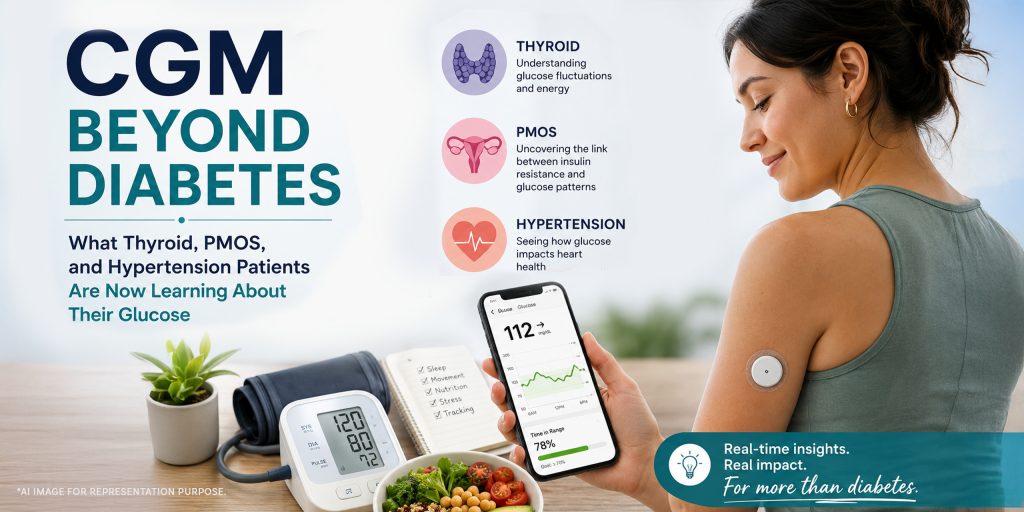
The thyroid is the body’s pacesetter, it decides how fast your engine runs. When thyroid hormone drifts too low or too high, your ability to handle sugar shifts with it. An underactive thyroid (hypothyroidism) can slow metabolism, add weight, and dull the response to insulin. An overactive thyroid (hyperthyroidism) can push sugar up and make levels swing unpredictably.
A thyroid condition does not mean diabetes is on its way. But watching your glucose patterns gives your doctor a fuller view, a way to judge how your metabolism is coping while your thyroid is being treated, rather than treating the two as difference conditions.
The shift in name from Polycystic Ovary Syndrome (PCOS) to Polyendocrine Metabolic Ovarian Syndrome (PMOS) carries an important message: this is not only about fertility. At its core it is also about how the body handles insulin and energy across the hormonal and metabolic system.
Here is the part that often surprises women, routine sugar tests can look perfectly normal, yet the body may still struggle to process glucose underneath. That hidden struggle shows up as stubborn weight gain, fatigue, and constant hunger that willpower alone never fixes. If that sounds like something you experience, the issue may not be discipline, it may be biology you cannot see. CGM lets you watch, in real time, how a meal, a walk, a stressful afternoon, or poor sleep moves your glucose, making change practical instead of guesswork.
High blood pressure and high blood sugar are old companions. They grow from the same soil, excess weight, too little movement, ongoing stress, and insulin resistance. Where one appears, the other is often nearby.
CGM cannot diagnose hypertension, and it is not meant to. What it can do is add another layer to your metabolic picture. For many people, simply seeing how often their glucose spikes becomes the nudge that finally motivates change, the kind that protects both blood pressure and the heart. Looked at side by side rather than in silos, these conditions tell your doctor a far more complete story about you.
The greatest strength of CGM is immediate, honest feedback which your body is answering in real time. You see how everyday choices shape your glucose, including:
Instead of guessing what helps and what harms, you watch your own body respond. That kind of lived evidence inspires healthier habits far more powerfully than advice ever could because this time, the proof is with you.
CGM is not reserved for a formal diabetes diagnosis. If any of the following describe you, a conversation with a doctor is a sensible next step:
Working from the medical reports and health assessments compiled by DiNC.AI, Tata MD’s Doctors look at your whole metabolic picture and just not blood sugar alone. Guided by your history, your risk factors, and your goals, they decide and guide how CGM will give you meaningful insight, earlier action, and care shaped around you.
Modern healthcare is steadily moving its gaze forward toward preventing and catching conditions early, rather than only treating them once they have taken hold. The most important health decisions are increasingly the ones we make before anything goes wrong.
Continuous Glucose Monitoring helps doctors understand the quiet conversation between your metabolism and your other conditions and translate it into care that is genuinely personal. For anyone living with diabetes, thyroid disorders, PMOS, or hypertension and Pregancy, tools like CGM offer clearer guidance, steadier decisions, and better long-term outcomes and perhaps the most valuable thing of all: the chance to know your body before it has to warn you.

Tata MD Healthcare Centre, 2nd Floor Prime Square, Sathya Sai layout, Whitefield, Bengaluru, Karnataka Pincode: 560066
View on Google Map
Monday to Saturday | 08:00 AM - 08:00 PM
Sunday | 10:00 AM - 02:00 PM