



Weight loss remains one of the most common health goals today. However, many people discover that losing weight is only one part of the journey. Maintaining that progress and improving overall health often requires consistent lifestyle changes and a long-term strategy.
In recent years, GLP-1 weight loss treatments have gained significant attention for their role in obesity management and metabolic health. At the same time, yoga continues to be recognized as a practical and accessible form of physical activity that can support overall well-being.
As we celebrate International Yoga Day, it is worth understanding how GLP-1 weight loss treatments and yoga for weight loss can work together to support sustainable weight loss and long-term metabolic health.
GLP-1 (Glucagon-Like Peptide-1) is a naturally occurring hormone that helps regulate appetite, food intake, and blood sugar levels.
Today, GLP-1 treatments are increasingly used under medical supervision to support weight management in appropriate individuals. These treatments may help reduce hunger, increase feelings of fullness, and support healthier eating habits.
The growing interest in GLP-1 weight loss reflects a shift toward evidence-based approaches to obesity management. However, medical treatment alone may not be enough to support long-term success. Sustainable results often depend on the healthy habits individuals build alongside treatment.
Many people focus on achieving rapid results. However, sustainable weight loss is about creating healthy changes that can be maintained over time.
Weight management is influenced by several factors, including nutrition, physical activity, sleep quality, stress levels, hormonal balance, and overall metabolic health. Addressing only one of these factors may not always lead to lasting results.
Successful weight management is not simply about reducing numbers on a weighing scale. It is also about improving energy levels, mobility, confidence, and overall quality of life.
This is why healthcare professionals increasingly focus on sustainable approaches that support both physical and metabolic health.
When people think about yoga, they often associate it with flexibility and relaxation. However, yoga for weight loss can offer benefits that extend beyond physical movement.
Consistency is one of the most important factors in sustainable weight loss. Yoga provides a form of movement that can be adapted to different fitness levels, making it easier for many individuals to incorporate regular physical activity into their daily routine.
Stress can influence eating habits, sleep quality, and overall health. Yoga combines movement, breathing exercises, and mindfulness techniques that may help support emotional well-being and stress management.
Yoga encourages individuals to become more aware of their bodies and daily habits. This awareness can support healthier lifestyle choices related to nutrition, movement, and self-care.
Regular movement and stress management play an important role in overall metabolic health. Yoga can complement other healthy lifestyle habits that support long-term wellness and weight management goals.
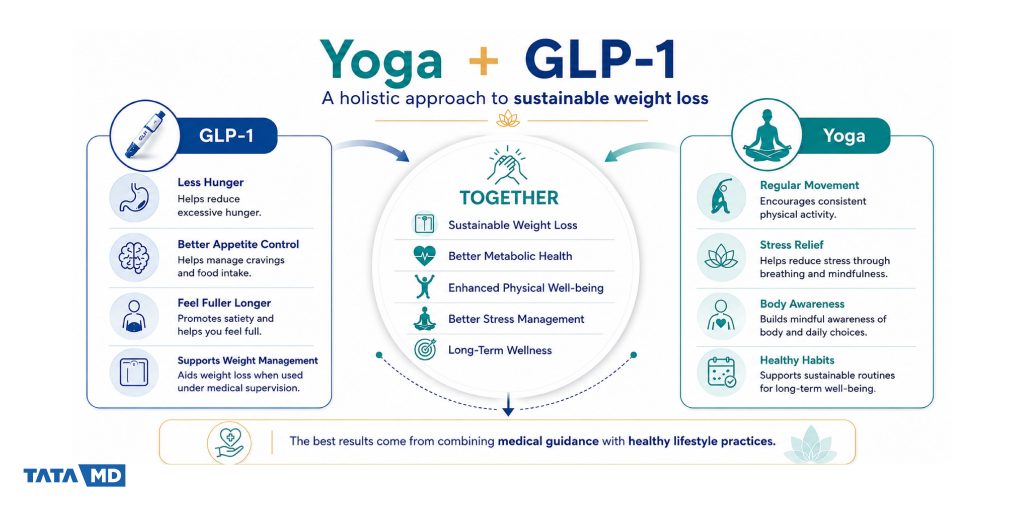
Rather than viewing them as separate approaches, GLP-1 weight loss treatments and yoga can be seen as complementary components of a broader health strategy.
GLP-1 treatment may help support appetite regulation and healthier eating behaviours. Yoga can help individuals develop routines and habits that support long-term well-being.
Together, they may contribute to:
For many individuals, a combination of medical guidance and healthy lifestyle practices can provide a stronger foundation for sustainable weight loss than relying on a single approach alone.
Many people assume that weight loss is simply about eating less or exercising more. Others believe that medication alone can solve long-term weight management challenges.
Obesity management is often influenced by a combination of biological, behavioural, lifestyle, and environmental factors. Sleep, stress, nutrition, physical activity, hormones, and underlying medical conditions can all play a role.
This is why successful weight management often involves a personalized approach that combines medical support, healthy lifestyle habits, and sustainable behavioural changes.
If you have been struggling with weight management, obesity, insulin resistance, prediabetes, or other metabolic health concerns, it may be beneficial to seek professional medical guidance.
An individualized assessment can help determine whether nutrition support, lifestyle modifications, physical activity interventions, or GLP-1 treatment may be appropriate based on your health profile and goals.
The most effective approach is one that is tailored to the individual rather than based on a one-size-fits-all solution.
Key Takeaways

Tata MD Healthcare Centre, 2nd Floor Prime Square, Sathya Sai layout, Whitefield, Bengaluru, Karnataka Pincode: 560066
View on Google Map
Monday to Saturday | 08:00 AM - 08:00 PM
Sunday | 10:00 AM - 02:00 PM