



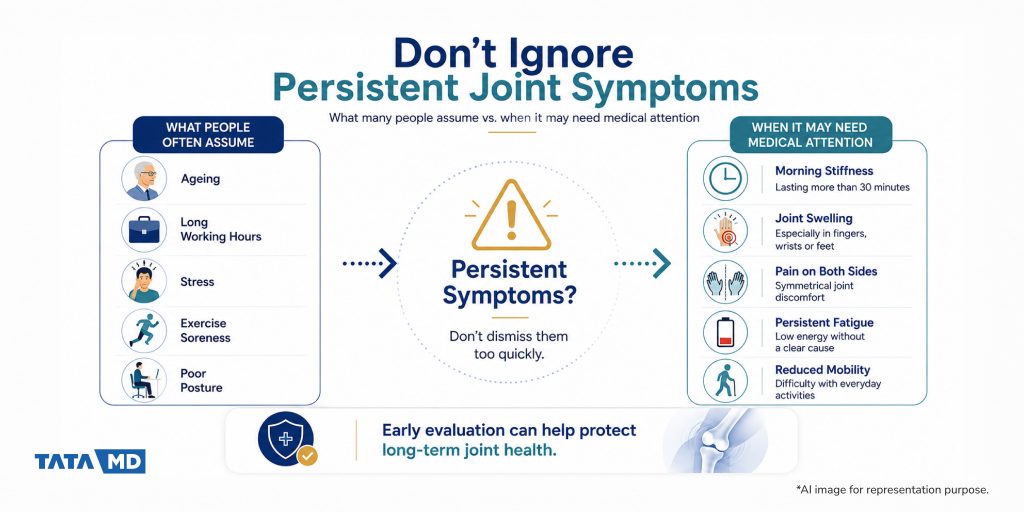
Joint pain, stiffness, and swelling are symptoms many people experience at some point in their lives. These symptoms are often attributed to ageing, long working hours, physical activity, or everyday stress. While occasional discomfort may not always be a cause for concern, persistent symptoms should never be ignored.
In some cases, these seemingly common symptoms can be among the early signs of Rheumatoid Arthritis, a chronic autoimmune condition that affects the joints and can impact quality of life if left untreated. Recognizing the early signs of Rheumatoid Arthritis can help support timely diagnosis and management, reducing the risk of long-term joint damage.
Rheumatoid Arthritis (RA) is an autoimmune disease in which the body’s immune system mistakenly attacks healthy joint tissues. This leads to inflammation, pain, swelling, and stiffness in the affected joints.
Unlike osteoarthritis, which is often associated with wear and tear of joints over time, Rheumatoid Arthritis is driven by inflammation and can affect people at different stages of life.
Because symptoms often develop gradually, many individuals may overlook the early signs of Rheumatoid Arthritis until the condition begins to affect daily activities.
One of the most common early signs of Rheumatoid Arthritis is prolonged morning stiffness.
Many people wake up with mild stiffness that improves within a few minutes. However, stiffness related to Rheumatoid Arthritis often lasts for 30 minutes or longer and may continue for several hours in some cases.
If morning stiffness becomes a regular pattern rather than an occasional occurrence, it may be worth seeking medical advice.
Persistent swelling in the small joints of the hands, fingers, wrists, or feet is another early sign of Rheumatoid Arthritis.
The swelling may not always be painful initially, which is why it is often ignored. Some people notice that rings feel tighter than usual or that their fingers appear puffy.
Inflammation-related swelling that continues for several weeks should be evaluated by a healthcare professional.
A characteristic feature of Rheumatoid Arthritis is that it often affects joints symmetrically.
For example, discomfort in one wrist may also be experienced in the other wrist. Similar patterns can occur in the fingers, knees, ankles, or feet.
This symmetrical pattern can help differentiate Rheumatoid Arthritis from other causes of joint pain.
The early signs of Rheumatoid Arthritis are not always limited to the joints.
Many people experience unexplained fatigue, low energy levels, or a general feeling of tiredness even before significant joint symptoms develop.
Because fatigue can result from many different causes, it is frequently overlooked. However, when fatigue occurs alongside joint pain or stiffness, it should not be ignored.
As inflammation affects the joints, simple everyday activities may become more challenging.
Tasks such as opening jars, gripping objects, typing for long periods, climbing stairs, or carrying household items may feel more difficult than before.
These changes often happen gradually, making them easy to dismiss. Paying attention to these subtle changes can help identify the condition earlier.
Many people delay seeking medical attention because they believe their symptoms are caused by:
While these factors can contribute to temporary discomfort, persistent symptoms should not automatically be dismissed. Early evaluation can help identify whether an underlying inflammatory condition is contributing to the problem.
It may be beneficial to consult a Rheumatologist if you experience:
Early diagnosis and appropriate management can help control symptoms and support better long-term outcomes.
The early signs of Rheumatoid Arthritis can often be subtle and easy to overlook. Symptoms such as morning stiffness, joint swelling, fatigue, symmetrical joint pain, and reduced mobility are frequently dismissed as part of everyday life. However, paying attention to these warning signs can make a significant difference.
Recognizing the early signs of Rheumatoid Arthritis and seeking timely medical guidance can help support better joint health, improve quality of life, and reduce the risk of long-term complications. When symptoms persist, it is always better to seek professional advice rather than wait for them to worsen.

Tata MD Healthcare Centre, 2nd Floor Prime Square, Sathya Sai layout, Whitefield, Bengaluru, Karnataka Pincode: 560066
View on Google Map
Monday to Saturday | 08:00 AM - 08:00 PM
Sunday | 10:00 AM - 02:00 PM